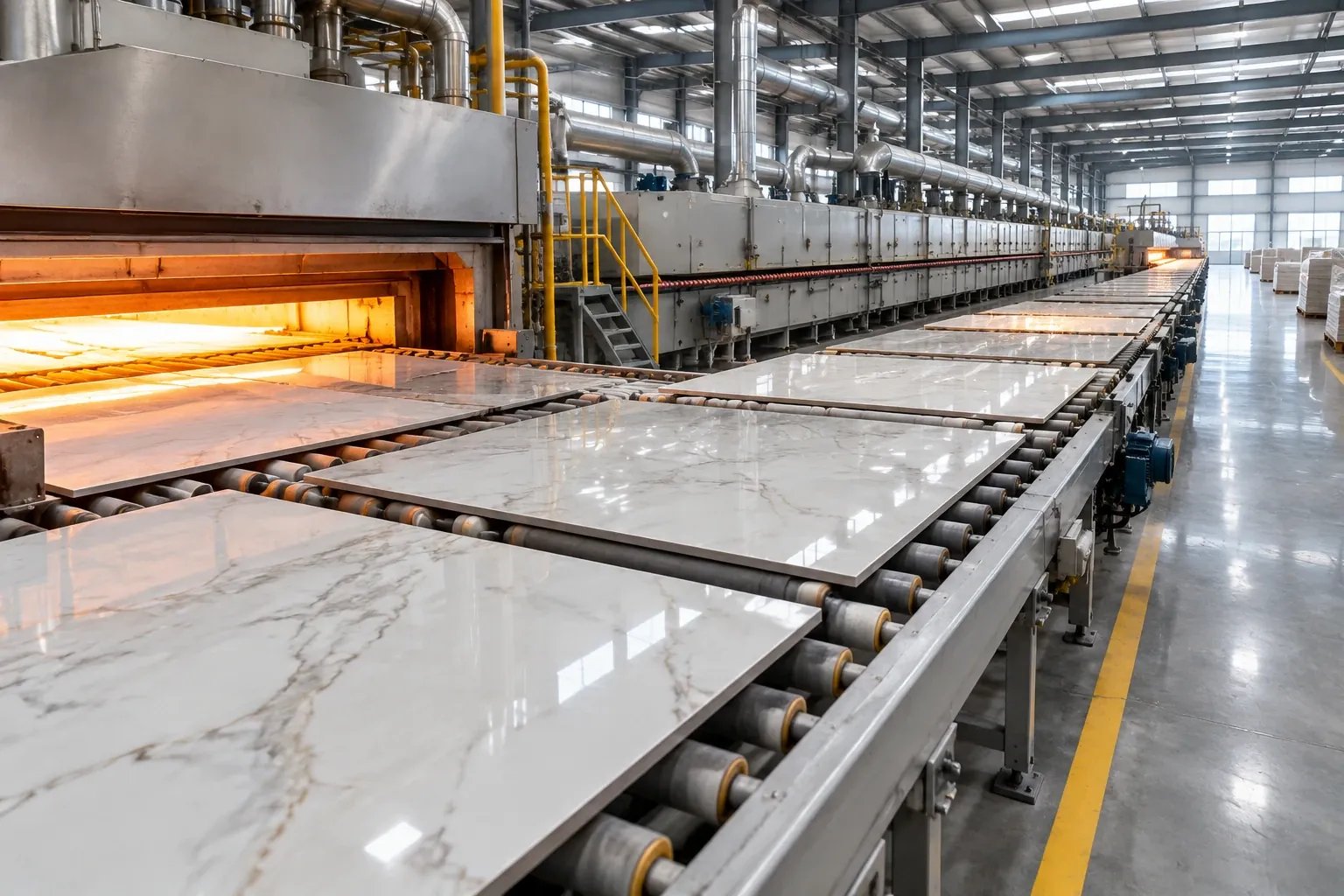
Iran produced 450 million m² of tiles in 2024, making it the world’s 5th-largest ceramic tile producer (Acimac/MECS Research Centre, Italy). For international buyers looking to source directly from an Iranian manufacturer, this guide walks through the full process — from understanding the production landscape to final customs clearance.
1. Iran’s Position in the Global Tile Industry
| Metric | Figure | Source |
|---|---|---|
| Global production rank | 5th | Acimac/MECS, Tehran Times |
| Annual production (2024) | 450 million m² | Acimac/MECS |
| Per-capita consumption | 4.8 m² (world average: ~3 m²) | IndexBox |
| Average export price (2024) | $5.4/m² (+7.4% YoY) | IndexBox |
| Export destinations | ~52 countries | DirectIran |
| Largest export market | Iraq | Manamaster, UN COMTRADE |
2. The Production Hub: Yazd / Ardakan / Meybod Cluster
The Yazd region combines Iran’s oldest ceramic tradition (Meybod, ~7,000 years of pottery-making history) with modern industrial infrastructure:
- ~101 active production units in Yazd province (Mordor Intelligence)
- The province produces roughly half of Iran’s national tile output (Iran Tiles & Ceramics Association, via IRNA/Financial Tribune)
- Direct access to local raw materials (clay, feldspar, kaolin) — reducing import dependence on raw materials by an estimated 70% (Araz Tile)
- Anchor factories in the region: Meybod Tile (operating since 1983), Ehsan Meybod Tile Factory (est. 1986), Mahtab Ardakan Tile (since 1988)
3. Quality Grades and Their International Equivalents
ISO 13006 defines only one official grade — “first quality.” Grades below that are industry-standard commercial conventions, not formal ISO classes.
| Iranian term | Italian equivalent | International equivalent |
|---|---|---|
| Grade A / Export Standard | Prima Scelta (First Choice) | First Quality / ISO First Quality |
| Grade B / Commercial | Prima Scelta Commerciale | Commercial Grade |
Industry rule of thumb: “First Choice” quality permits a maximum of 5 defective tiles per 100 (Arch. Bernardo Callai). Always request the exact grade breakdown of your order in writing on the invoice.
4. Customs Tariff Codes (HS Codes)
| HS Code | Description |
|---|---|
6907.21 |
Water absorption ≤0.5% (porcelain) |
6907.22 |
Water absorption 0.5%–10% (standard ceramic) |
6907.23 |
Water absorption >10% (lightweight wall tile) |
5. A Major Trade Opportunity: The EAEU–Iran Free Trade Agreement
Since 15 May 2025, a full free trade agreement between Iran and the Eurasian Economic Union (Russia, Armenia, Kazakhstan, Belarus, Kyrgyzstan) has been in force (Eurasian Economic Commission, official):
“The average rate of import customs duty on goods supplied from the Union to Iran will decrease from 20% to 4.5%,” with preferential coverage extending to 90% of the commodity nomenclature.
What this means for buyers in Russia, Armenia, or Kazakhstan: importing tile from Khatam can now be done at a substantially lower tariff than before — a genuine competitive advantage worth highlighting in negotiations with these markets.
6. Export Clearance Process, Step by Step
- Proforma Invoice — technical specifications, quantity, Incoterm
- Production and Quality Control — third-party pre-shipment inspection available
- Packing and Palletization — including ISPM 15 requirements for wooden pallets (see our container logistics guide)
- Certificate of Origin — issued by the Iran Chamber of Commerce, Industries, Mines & Agriculture
- Export permit and customs documentation
- Shipment and final documents — Bill of Lading, commercial invoice, Certificate of Origin, and, where required, a wood packaging phytosanitary certificate
7. Payment Routing — Transparency from the Start
Due to international banking restrictions, commercial payments to Iran are generally routed through regional settlement channels rather than direct SWIFT transfers. It’s worth noting that the UAE channel — historically a primary settlement route for many Iranian exporters — has faced new restrictions since mid-2025, prompting many international buyers to shift toward alternative routes (regional settlement within the EAEU framework, or direct coordination with established exchange houses).
Our recommendation: before finalizing a contract, coordinate a workable payment route compliant with your own country’s regulations with Khatam’s sales team directly — this upfront transparency prevents misunderstandings later.
Conclusion
Buyers who clearly document the quality grade, knowingly leverage tariff advantages (like the EAEU agreement), and coordinate payment routing from the outset minimize transaction risk substantially.
Sources: Acimac/MECS Research Centre; IndexBox; Tehran Times; Mordor Intelligence; Eurasian Economic Commission; Iran Chamber of Commerce.
If you’re sourcing porcelain tile for an upcoming order, feel free to get in touch through our quote form browse the current catalog by material, size, or finish, or start from our Iranian porcelain tiles page, with sizes, thickness and loading figures.