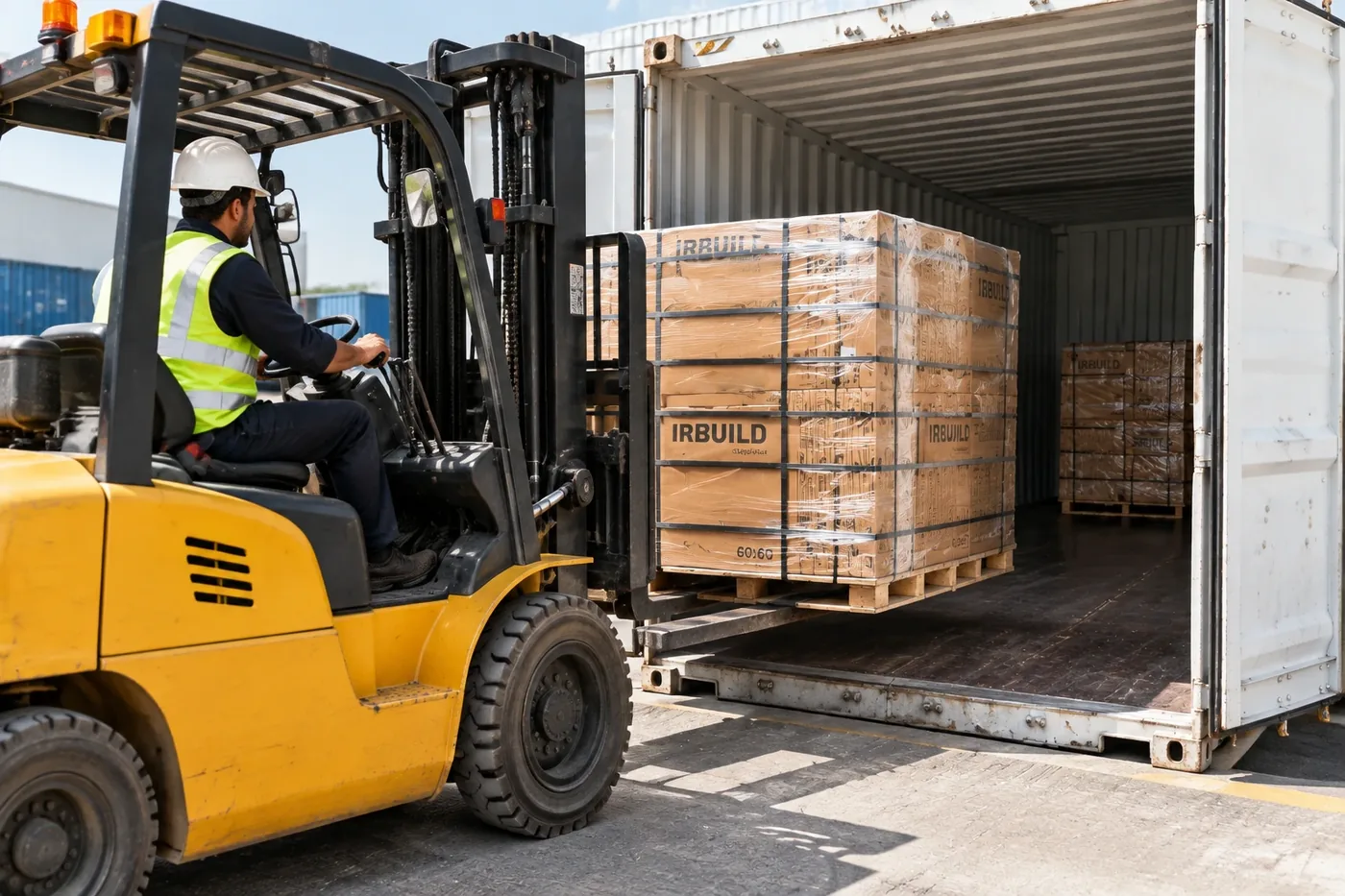
1. The Key Fact Most Buyers Don’t Know: Tile Is Weight-Limited, Not Volume-Limited
| Container type | Tare weight | Max payload | Max gross weight |
|---|---|---|---|
| 20ft standard | ~2,300 kg | ~28,200 kg | ~30,480 kg |
| 40ft standard | ~3,750 kg | ~28,800 kg | ~30,480 kg |
(Sources: Riwick, iContainers, FreightAmigo)
The critical insight: a 40ft container has only about 600 kg more weight capacity than a 20ft, despite having roughly double the internal volume. Because tile is a heavy, low-volume product, you hit the weight ceiling long before you hit the volume ceiling.
Practical takeaway for buyers: a 20ft container of 9–10mm porcelain typically holds around 1,300 m², and a 40ft container holds roughly the same amount — not double — because both reach a similar weight ceiling (~28–28.8 tonnes) before the container’s empty space is filled. This matters most for buyers who assume booking a larger container means “double the cargo.”
2. Palletization Specs by Tile Size
| Tile size | Pieces per box | m² per box | Approx. pallet weight |
|---|---|---|---|
| 60×60 cm | 4 pcs | 1.44 | ~1,120–1,130 kg [factory data needed] |
| 80×80 cm | 3 pcs | 1.92 | ~1,225 kg [factory data needed] |
| 100×100 cm | 2 pcs | 2.00 | ~1,300–1,400 kg [factory data needed] |
Base data from Gujarat, India-based exporters (Eagle Assurance House, Bavarva Ceramic, Marazen Tiles) — replace with Khatam’s actual packing list before final publication.
3. ISPM 15 Wood Packaging Compliance
Mandatory in over 180 countries. Non-compliance can trigger fines up to 3x the cargo value, forced fumigation, or destruction of goods at destination (IPPC/FAO).
- Wood must be debarked
- Two accepted treatment methods: heat treatment (HT: core temperature of 56°C for at least 30 minutes) or methyl bromide fumigation (MB)
- The IPPC stamp (“wheat mark”) must include: the IPPC symbol + two-letter country code + facility registration number + treatment code, separated by a vertical divider line — and must be stamped, never hand-painted
- The stamp must appear on at least two opposite sides of the pallet
4. Moisture Protection
- Dry, treated wooden pallets
- Stretch wrap around the entire pallet
- Desiccant bags inside the container to prevent “container rain” (condensation from temperature swings at sea)
5. Preventing Breakage — Professional Techniques
Per an industry case study (Riwick):
- Flat-stacked packing without proper locking can cause 4–6% breakage
- Switching to on-edge packing with 10mm EPE foam inserts between tiles reduces breakage to under 2% (roughly a 60% reduction in claim costs)
- Per IMO cargo-securing guidance, about 30% of in-container damage results from cargo shift, not direct impact
Additional best practices:
- Securing pallets to the container floor with strapping or wooden blocks
- Using air pillows / dunnage bags to fill empty space and prevent lateral shift
- Distributing weight evenly (50/50) front-to-back in the container
- Requesting photos of the loaded container before the doors are sealed, for documentation in case of a later dispute
6. Incoterms and Breakage Risk Transfer
| Incoterm | Who pays freight | Who bears in-transit breakage risk? |
|---|---|---|
| FOB | Buyer | Buyer — from the moment goods are loaded at the port of origin |
| CFR | Seller (freight only) | Buyer — risk still transfers at the loading port |
| CIF | Seller (freight + minimum insurance) | Buyer, but insurance is already in place |
Important recommendation: regardless of the chosen Incoterm, for a fragile cargo like tile, always ensure full marine cargo insurance is in force — whether through CIF or a separate policy under FOB/CFR.
Conclusion
Proper tile logistics means calculating weight precisely (not just pallet count), standardized palletization, ISPM 15 compliance, and clarity on risk transfer — all of which directly affect breakage rates and buyer satisfaction at destination.
Sources: Riwick; iContainers; FreightAmigo; IPPC/FAO (ISPM 15); IMO cargo-securing guidance; ISO 668.
For real pallet and load figures by tile body, see our size pages, for example 60x60 porcelain tiles and 60x120 porcelain tiles, or the porcelain and ceramic floor tiles overview, which compares the load per container for every floor size. To combine several designs or sizes in one load, see Tile MOQ and Mixed Container Loads.
Have a specific container plan you want reviewed? Get in touch through our quote form and we’ll help work out the loading and packing details for your order.